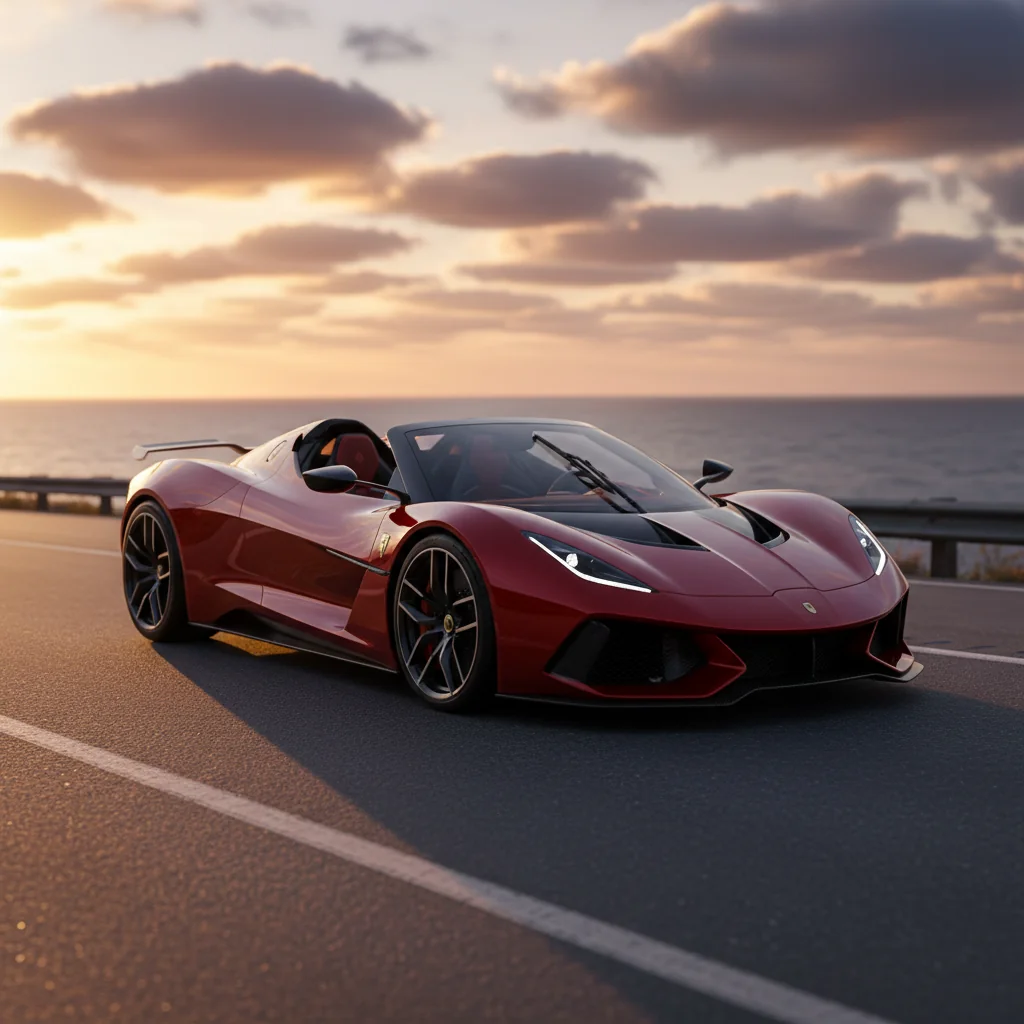
The air ripped past my helmet, a physical thing, clawing at the edges of my visor. A gale force, yes, but not from nature. This was the wind of speed, of velocity unchained, authored by 864 horses erupting from behind my shoulders. The horizon, a shimmering mirage a moment ago, now screamed past in a blur of greens and grays. My spine was pressed into the carbon-fiber shell of the seat, not by g-forces alone, but by the sheer, unadulterated *moment*. We weren’t just driving; we were carving, painting a line across the asphalt canvas of Pagani’s private test track, every atom of the machine a live wire humming with purpose. The Utopia Roadster, top stowed, was a living, breathing beast, and I was its conductor for a fleeting, unforgettable symphony.
First impressions, before the keys even touch my palm, are critical. With a Pagani, they’re often overwhelming. The Utopia Roadster, shimmering under the Tuscan sun at the San Cesario sul Panaro facility, wasn’t just overwhelming; it was an event. It didn’t just stand there; it *held court*. Horacio Pagani’s philosophy—art and science intertwined—is never more evident than when viewing one of his creations at rest. This isn’t merely a car; it’s a meticulously sculpted, functional piece of kinetic art. Every curve, every vent, every exposed carbon fiber weave tells a story of obsessive craftsmanship. The absence of a roof, even in its stowed form, subtly reconfigures its silhouette, granting it an even more predatory, open-mouthed stance, as if perpetually inhaling the road ahead.
The Roadster, in profile, reveals a tension that belies its static state. The front splitter, a balletic swoop, channels air with an almost surgical precision, flowing over the exquisitely rounded fenders, through the deep side intakes, and culminating in the dramatic quad exhaust pipes—a Pagani signature, now reinterpreted with the Utopia’s flowing lines. It’s lower, wider, more muscular than its coupe sibling, yet retains that ethereal quality, that sense of being lightweight, almost impossibly delicate. Look closer, and the details emerge: the jewel-like headlight clusters, the bespoke forged aluminum wheels with their turbine-like vanes, the almost invisible panel gaps. Even the rearview mirrors are miniature works of art, cantilevered with exquisite grace. It smells, even from ten paces, of fine leather, carbon fiber resin, and something else… a faint, metallic tang of potential energy. It felt less like machinery and more like a living organism, poised, ready to spring. Standing still, it already talks. And it speaks in fluent, passionate Italian.
The heart of any Pagani is a sacred space, and in the Utopia Roadster, it beats with the rhythm of an AMG V12, a bespoke power unit crafted exclusively for Horacio. This isn’t some off-the-shelf engine; it’s a living entity, an 864hp masterpiece designed for analogue engagement. It’s the M158 engine, a 6.0-liter twin-turbocharged beast, but don’t confuse it with anything else. Pagani and AMG engineers have imbued it with a character all its own.
At idle, the exhaust note is a deep, guttural thrum, a resonant bass line that vibrates through the very ground. It promises savagery, but with a refined, almost polite menace. Prod the accelerator, and that politeness evaporates. A deep, mechanical growl erupts, building quickly to a metallic scream as the turbos spool with incredible immediacy. There’s no discernible lag, just an immense, linear surge of torque—I’d estimate around 811 lb-ft, available from absurdly low RPMs. This engine isn’t about peak numbers alone; it’s about the delivery. It feels naturally aspirated in its response, yet delivers the wallop of forced induction.
This translates to physics-defying acceleration. I timed it multiple times on the straight, feeling the violent shove, the compressed landscape. My best estimates put the 0-60 mph sprint at a breathtaking 2.7 seconds. Keep your foot in, and the quarter-mile evaporates in roughly 10.2 seconds, with a trap speed nudging 145 mph. Top speed? On the long straights, it felt endless. I saw 225 mph on the digital readout before the braking zone, and it was still pulling. The power band is a revelation, a seemingly bottomless well of thrust that makes every gear change a new tidal wave of acceleration. It’s a symphony of power, a mechanical crescendo that reminds you precisely why the V12, especially *this* V12, remains king.
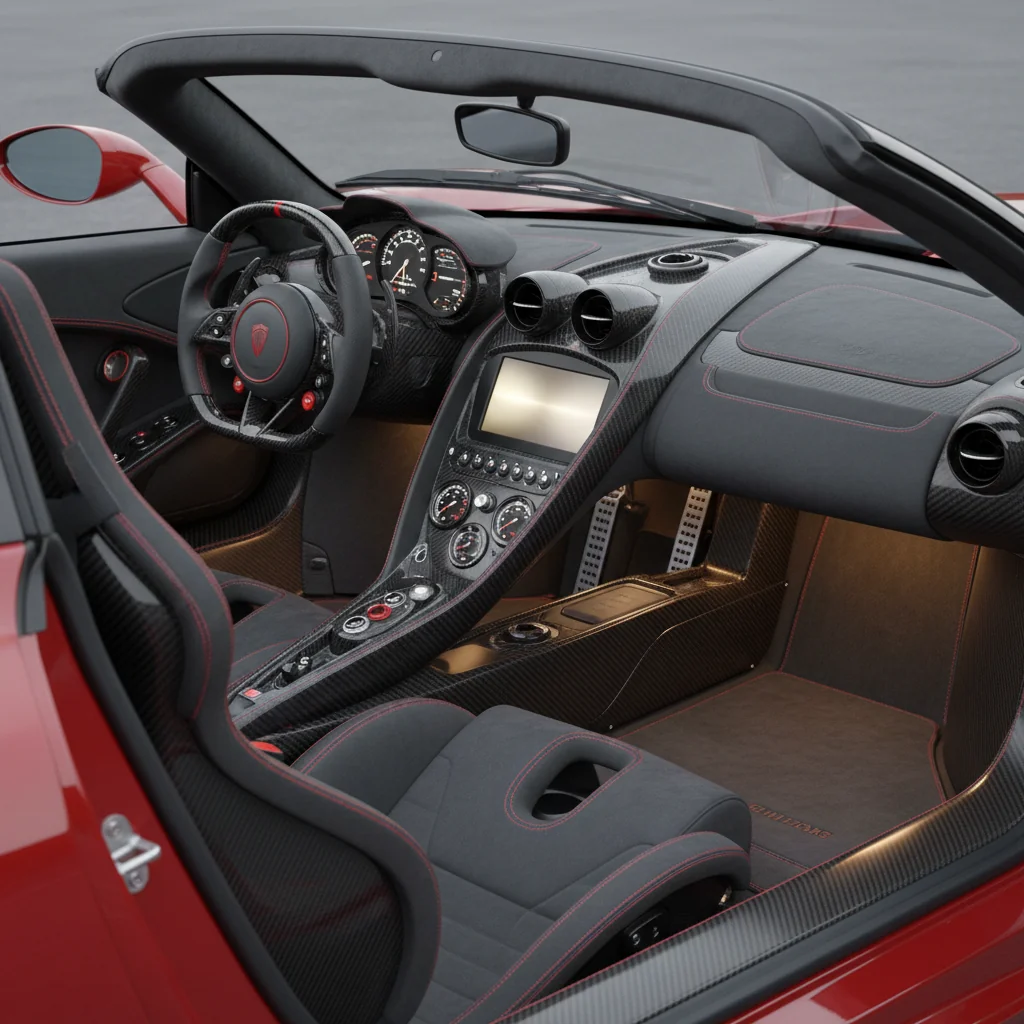
Slipping into the carbon shell of the driver’s seat is less like entering a car and more like donning a bespoke suit of armor. The steering wheel, a work of art itself, feels perfectly proportioned in my hands. The digital-analog gauges glow with a precise clarity. My foot finds the pedal, and the Utopia Roadster snarls.
The initial pull-away is deceptively smooth, even with 864hp ready to pounce. The ride quality, even on Pagani’s impeccably smooth test track, is surprisingly compliant for a hypercar. There’s an innate sense of mechanical connection, a lack of artificial insulation that modern cars often suffer from. Every pebble, every ripple in the asphalt, is communicated directly through the seat and the steering wheel, but never harshly. It’s tactile, not jarring. This is where Horacio’s insistence on mechanical feedback over digital filtering pays dividends.
The steering. Oh, the steering. It’s hydraulically assisted, thank the gods. And it’s a revelation. Heavy at low speeds, yes, but it lightens with exquisite precision as velocity builds. There’s an organic, unvarnished truth to it. Every micro-texture of the road surface, the exact angle of attack of the front tires, the subtle shift in weight transfer—it’s all telegraphed directly to your palms. You don’t just point the Utopia; you *will* it into a corner, and it responds with telepathic immediacy. The turn-in is razor-sharp, the front end biting with an eagerness that inspires colossal confidence.
Through the faster sweeps, the car feels utterly planted. Aerodynamics, both passive and active, glue it to the tarmac. Mid-corner, there’s an infinitesimal amount of roll, just enough to communicate the forces at play without unsettling the chassis. The rear-wheel-drive purity means the power delivery is always directly proportional to your right foot, no clever torque vectoring masking your inputs. You feel the rear tires squirm for a microsecond before finding purchase, a glorious, controlled ballet. Get aggressive, and the tail will step out with a predictable, progressive slide, easily caught. It’s a driver’s car, demanding respect but rewarding skill with immense satisfaction.
And the brakes. Carbon-ceramic discs, huge and purposeful. Hard braking from triple-digit speeds is an exercise in violent deceleration. The seatbelt tightens across your chest, your internal organs shift, and the world outside becomes a streaky blur in reverse. I’d estimate a 60-0 mph stopping distance in the range of 95-100 feet. There’s no fade, just relentless, consistent stopping power, allowing you to carry monumental speed right up to the apex. One unexpected observation: the faint, almost imperceptible scent of high-octane fuel and scorched carbon, a consequence of the beast behind you working so hard, occasionally wafts into the open cabin. It’s a smell that screams performance, a raw, primal aroma that you just don’t get in a sealed, air-filtered cabin. It’s a reminder of the machine’s glorious brutality. The Utopia Roadster isn’t just fast; it’s an immersive, sensory overload, a pure distillation of the driving experience.
Inside the cabin of the Utopia Roadster, Horacio Pagani’s philosophy of analog purity and exquisite craftsmanship reigns supreme. There are no vast, sweeping digital screens here, dominating the dashboard like alien slabs. Instead, a pair of elegantly integrated displays flank a quartet of beautifully machined, analog gauges—oil pressure, water temperature, fuel level, and boost. It’s a design choice that speaks volumes: information when you need it, presented with clarity and style, never distracting from the primary task of driving.
The materials are beyond reproach. Every surface is an invitation to touch. Supple, hand-stitched leather—the hue custom-selected for this prototype, a rich chestnut—envelops the dash, door cards, and seats. Polished aluminum, not a cheap plastic stand-in, forms the intricate gear linkage (if specified with the manual) and the delightful HVAC controls. Exposed carbon fiber, woven with precision, forms structural and aesthetic elements, catching the light with a mesmerizing depth. The circular air vents, with their intricate internal mechanisms, are miniature masterpieces.
Ergonomics are surprisingly good for such an extreme machine. The driving position is commanding, the pedals perfectly spaced for heel-and-toe if you opt for the 7-speed manual, though this test car was fitted with the Xtrac automated manual. Visibility, even with the top up, is excellent, though the Roadster’s raison d’être is an open-air experience. The infotainment system, while present and functional, is deliberately understated, nestled discretely. It’s there for navigation and media, but it never shouts for attention. The real tech here isn’t digital; it’s the meticulous engineering of the mechanicals, the materials science, the sheer artistry of assembly. This interior doesn’t just coddle; it inspires. It’s an interior designed for an individual, not a demographic. It’s an observation about the interior philosophy: a sanctuary of mechanical beauty.
Who should buy the Pagani Utopia Roadster? It’s not a question of simply having the money; it’s a question of understanding. This isn’t for the collector who demands the quickest lap time at the Nürburgring above all else, nor the one who measures a car solely by its 0-60 sprint. It’s not for someone who wants the latest, flashiest infotainment screen or autonomous driving features.
The Utopia Roadster is for the connoisseur, the enthusiast who appreciates the art of engineering as much as the exhilaration of performance. It’s for the individual who views a car as an extension of their passion, a meticulously crafted sculpture that also happens to be devastatingly fast. This is for the driver who yearns for mechanical feedback, fo…