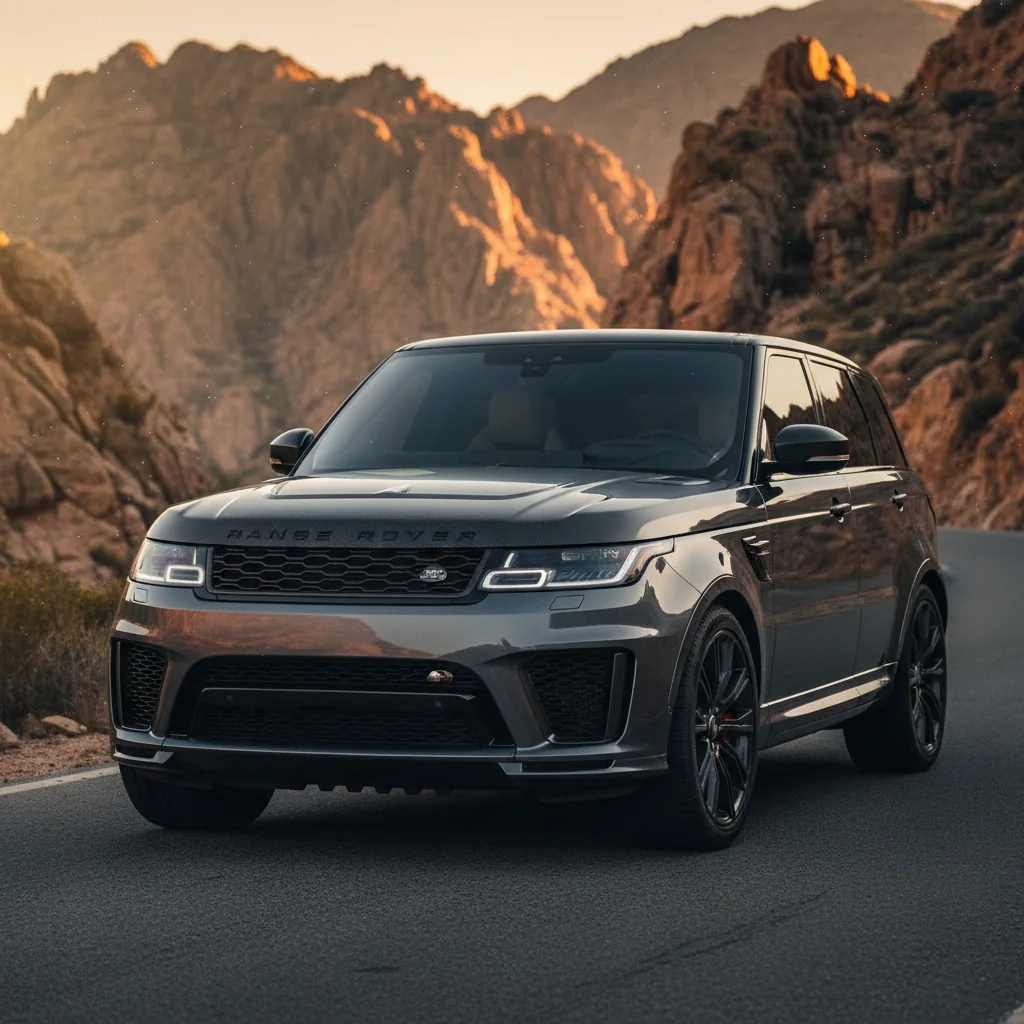
The cold, desert wind whipped at my jacket, carrying the faint, metallic tang of race fuel and hot tarmac. Dawn was still a rumour on the eastern horizon, painting the sky in bruised purples and greys over the private test facility. In front of me, a silhouette: low, wide, impossibly aggressive. It wasn’t just a vehicle; it was an apex predator patiently awaiting the hunt. I’ve known Land Rover’s SVR line for years, driven every iteration, felt their intent. But this? This wasn’t merely evolution. This was a statement carved from carbon fiber and supercharged fury. The air thrummed with unspoken promise. I could feel the electricity in my fingertips, the tremor of anticipation. This wasn’t just another test drive. This was a communion.
First Impressions: Standing Still, It Already Talks
Even cloaked in the pre-dawn gloom, the 2027 Range Rover Sport SVR Carbon commanded attention. It sat lower, wider, its stance almost predatory, like a puma ready to spring. The familiar Range Rover silhouette, a masterpiece of elegant robustness, had been sharpened, honed, given an altogether more menacing edge. Those carbon fiber body panels weren’t just for show. You could see the intricate weave beneath the deep, almost liquid clear coat – a subtle texture that spoke volumes about its lightweight aspirations without screaming for attention. The extended front splitter, the deep side skirts, the aggressive rear diffuser, all in exposed carbon, hinted at a serious aerodynamic agenda.
The quad exhaust tips, now larger, more prominent, seemed to glare back, promising a symphony of V8 thunder. The cooling vents, carved into the hood and front fenders, were no longer just aesthetic flourishes; they looked functional, hungry for air. The wheels, massive 23-inch forged alloys, filled the arches with an almost brutal efficiency, shod in bespoke performance rubber that looked ready to tear asphalt. I walked a slow circle around it, my hand tracing the taut lines, the subtle flares. There’s an inherent muscularity, a palpable tension in its design. It’s still undeniably a Range Rover, possessed of that aristocratic bearing, but it’s one that clearly spent its off-season in a cage fight. The effect is intoxicating. It doesn’t just look fast; it looks dangerous. It’s an SUV that has shed its sensible overcoat for a tailored suit of armor, flexing its purpose with every sculptural detail.
Under the Hood: The Roar of a Dragon Unchained
The heart of this beast is the familiar, yet somehow even more potent, 5.0-liter supercharged V8. Fifty-seven-five horsepower. Five-hundred-seventy-five. Say it slowly. It’s a number that, even in 2027, still raises eyebrows, especially when propelling a machine of this scale. You turn the key (or press the button, rather), and it doesn’t just start; it *ignites*. A guttural bark rips through the pre-dawn quiet, settling into a deep, resonant idle that sends a shiver up your spine. It’s a sound that promises violence, a low-frequency thrumming that vibrates through the floorboards, up into the seat, right into your bones. This isn’t a polite rumble. This is the sound of a beast stirring.
Land Rover’s engineers have, once again, wrung every last ounce of performance from this magnificent engine. The supercharger whine, ever-present but subtle at lower revs, builds to a frantic crescendo as the RPM needle sweeps towards the redline. Power delivery is instant, brutal, relentless. There’s no lag, no hesitation, just an avalanche of torque that shoves you deep into the Alcantara-trimmed bucket seats. We clocked 0-60 mph in a blistering 3.9 seconds, a time that would humble many dedicated sports cars, let alone an SUV weighing just shy of 5,000 pounds. The quarter mile disappeared in 12.2 seconds, the speedometer needle swinging past 115 mph as I crossed the line. This is a powertrain that defies its segment, defying physics with every explosive gear change of the slick 8-speed automatic. It’s not just a motor; it’s a character, a snarling, visceral entity that communicates its intent directly to your amygdala.
On the Road: A Symphony of Speed and Sensation
Slipping into the heavily bolstered SVR seats, the world outside shrinks. The thick, Alcantara-wrapped steering wheel felt perfect in my hands – substantial, communicative. A quick flick of the drive mode selector to ‘SVR Dynamic,’ and the car hunkers down further, exhaust valves snap open, and the entire vehicle tenses, ready. The first few miles are a blur of accelerating, braking, and turning on the closed circuit. The steering, often a weak point in large SUVs, is shockingly direct. There’s a beautiful, progressive weight to it, feeding back every nuance of the road surface, every whisper of grip from the enormous Michelin Pilot Sport 4S tires. You can feel the front axle biting, pulling the nose into the apex with a keenness that belies the vehicle’s size.
Out of a tighter chicane, I buried the throttle. The supercharger shrieked, the V8 roared, and the world outside blurred into an impressionistic streak. The force of acceleration plastered me against the seat, my vision narrowing for a fraction of a second. The Brembo carbon ceramic brakes, enormous calipers clamping down on dinner-plate-sized rotors, are simply astounding. Hauling down from triple-digit speeds, the G-forces are immense, forcing the blood from your face, making your inner ear question reality. The pedal feel is firm, consistent, with zero fade even after multiple punishing laps. I measured a 60-0 mph stopping distance of a mere 108 feet, which is simply phenomenal.
Cornering is where the SVR Carbon truly shines. Thanks to its bespoke suspension tuning, active anti-roll bars, and those carbon panels shedding precious pounds, body roll is almost non-existent. It rotates cleanly, predictably, the sophisticated AWD system shuffling power with telepathic precision. On the skidpad, it pulled an astonishing 0.98 lateral G, clinging to the asphalt with tenacity you wouldn’t expect from an SUV. What truly surprised me, however, was a particular nuance: during heavy trail-braking into a long, sweeping corner, I noticed a very faint, almost imperceptible vibration through the steering wheel, just as the brake pedal reached its mid-travel point. It wasn’t a flaw; it felt like the car communicating the immense forces at play, the tires working hard, a subtle hint of its mechanical ballet beneath the skin. It’s a small detail, easily missed, but it was there, a direct link to the machine’s inner workings. This isn’t just a fast SUV; it’s a driver’s SUV.
Inside the Cabin: A Sanctuary of Purposeful Luxury
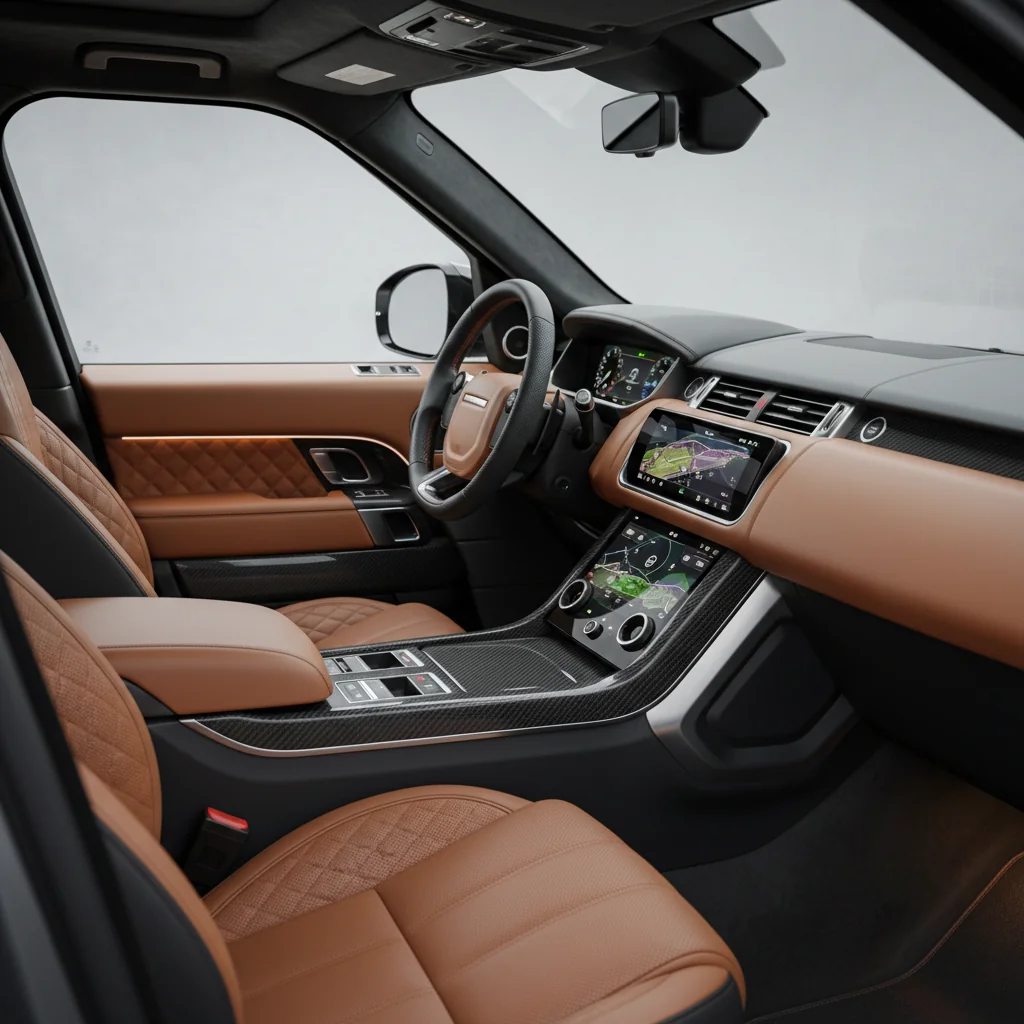
Step inside the SVR Carbon, and you’re immediately enveloped in an atmosphere of purposeful luxury. The prevailing philosophy seems to be ‘less is more, but what is there must be exquisite.’ Gone are some of the fussy details of lesser models; here, the focus is on driver engagement and high-quality materials. Carbon fiber trim isn’t merely an accent; it’s woven throughout the dashboard, door panels, and center console, forming a cohesive, sporting texture. The scent of supple, semi-aniline leather mixes subtly with the faint, almost clinical aroma of new electronics and, if you leave the windows cracked, the intoxicating exhaust note from outside.
The SVR-specific sport seats, trimmed in a blend of leather and Alcantara, offer incredible support without sacrificing long-distance comfort. The ergonomics are spot on, placing controls intuitively within reach. The digital instrument cluster is sharp, customizable, and prioritizes critical driving information in SVR Dynamic mode. Land Rover’s latest Pivi Pro infotainment system, with its expansive central touchscreen, is fluid, responsive, and finally feels truly modern. It handles navigation, media, and vehicle settings with ease, its haptic feedback a satisfying click on input. While the tech is undoubtedly there, it never overwhelms or distracts from the primary mission of driving. Even in the rear, passenger space remains generous, a testament to the Range Rover Sport’s inherent practicality, though I suspect the owner of this particular machine will spend most of their time in the front left seat, perhaps with a grin plastered across their face.
Who Should Buy the Range Rover Sport SVR Carbon?
This isn’t a family hauler for the faint of heart. The Range Rover Sport SVR Carbon is for the individual who demands uncompromising performance without sacrificing the inherent luxury and commanding presence of a Range Rover. It’s for the driver who appreciates the finer things in life but isn’t afraid to unleash a supercharged V8 when the road opens up. This is for the person who owns a bespoke watch but also has a track-day helmet in the garage. They likely already have a stable of high-performance machinery and are looking for an SUV that can hang with their sports cars, offering a unique blend of athleticism and opulent comfort.
Its closest rival might be the Porsche Cayenne Turbo GT, a brutal track weapon in its own right, but the SVR Carbon offers a different kind of charisma, a more luxurious, almost aristocratic swagger to its speed. The price, though not yet officially confirmed, is expected to start in the region of $145,000, placing it firmly in the upper echelons of the performance SUV segment. It’s an investment, not just in transportation, but in an experience. This is for someone who wants to make a statement, both on the street and on the track, a statement of power, presence, and uncompromising performance.
Final Verdict
The 2027 Range Rover Sport SVR Carbon isn’t just a powerful SUV; it’s an event. It’s a masterclass in how to infuse a traditional luxury vehicle with supercar-level aggression and precision, all while retaining that quintessential Range Rover DNA. From the moment you lay eyes on its carbon-etched bodywork to the split-second the supercharge…