The first brush of Alcantara against my fingertips, the faint metallic tang of a hot engine oil carried on the breeze through the open window, the low thrum of the 1.8-liter turbo settling into an idle that vibrated subtly through the carbon shell of the seat – these are the initial whispers. But then, the throttle blip. A sharp, guttural bark that rips through the still air of the test track, a sound completely disproportionate to the engine’s diminutive size. It promises something primal. Something untamed. Something utterly Alpine. I’ve known this feeling before, standing trackside in Lapland, or waiting in the pit lane at Ehra-Lessien. It’s the prelude to an experience, a visceral connection to a machine built for a singular, glorious purpose: to make you *feel* alive. The 2027 Alpine A110 R Turini isn’t just a car; it’s an awakening.
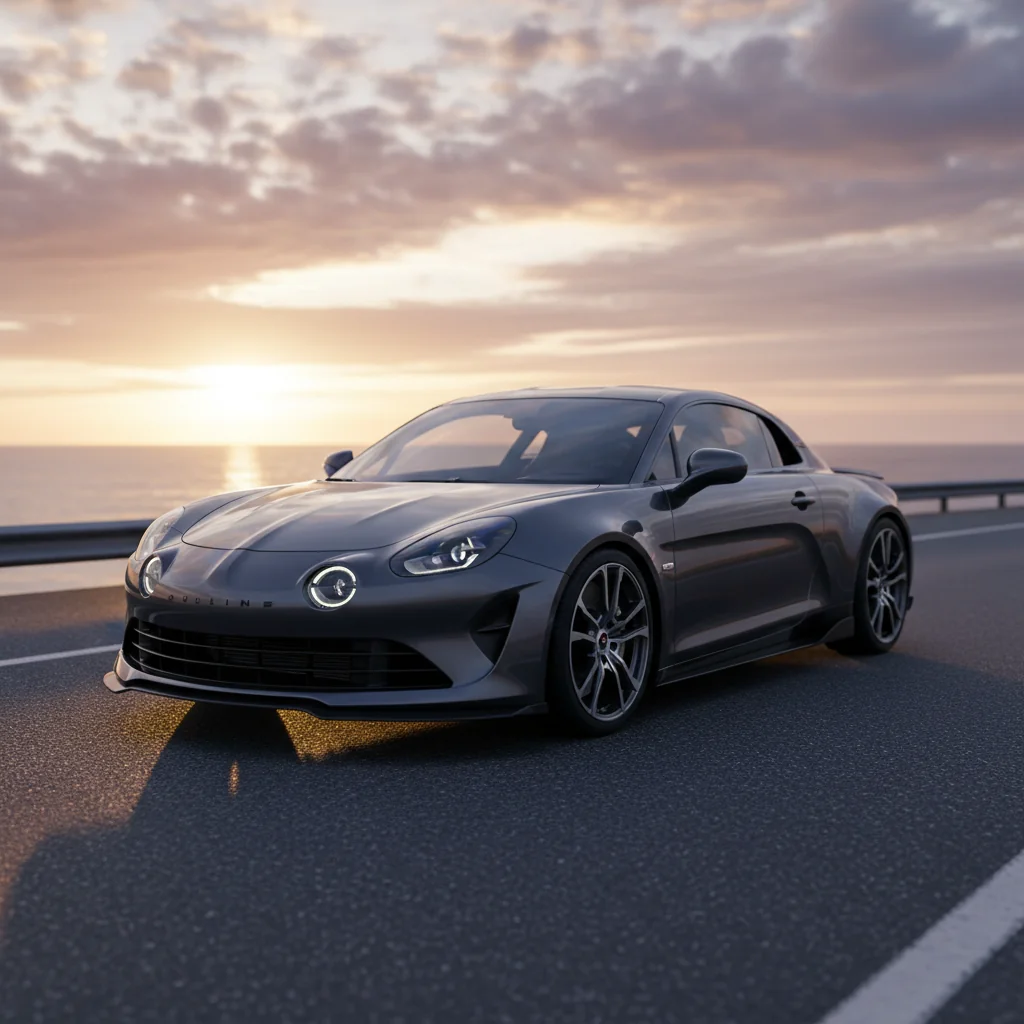
Standing before the A110 R Turini, nestled in the morning light of the private test facility, it wasn’t merely a static object. It was a coiled spring. Even at rest, its form spoke volumes. The standard A110’s inherent beauty, that classic, almost liquid shape inspired by its rally-bred ancestors, has been sharpened, honed, and then given a brutal edge. This Turini variant, cloaked in a deep, almost iridescent French racing blue that seemed to shift with the light, held a presence that belied its compact footprint.
The carbon fiber weave was everywhere, not just a subtle accent, but an integral part of its being. The aggressive front splitter, the enlarged air intakes that looked ready to devour the very air itself, the deep side skirts, and that magnificent rear wing – all rendered in a matte carbon that swallowed light and screamed intent. It’s functional art. The delicate, almost wispy 18-inch forged wheels, specific to the Turini, exposed the massive Brembo calipers, painted in a defiant gold, hinting at stopping power that could warp spacetime. The stance was lower, wider, more predatory. Its gaze, through those quad LED headlights, felt focused, intense.
This isn’t a car that shouts for attention with outlandish dimensions or an exaggerated silhouette. No, the A110 R Turini works in whispers and subtle flexes. It draws you in with its inherent rightness, its balance, its compact aggression. There’s an honesty to its design that bypasses the superficial. It doesn’t need to be a supercar to convey supercar-level purpose. It’s an athlete in a bespoke suit, lean, muscular, and ready to sprint. You don’t just look at it; you mentally trace the airflow over its surfaces, feel the grip of those Michelin Pilot Sport Cup 2s through the tarmac. It already makes you imagine the drive.
The heart of the A110 R Turini is, on paper, deceptively modest: a 1.8-liter turbocharged inline-four. Yet, dismissing it as merely “small” would be a profound oversight, a fundamental misunderstanding of Alpine’s engineering philosophy. This isn’t a brute; it’s a finely tuned instrument. Alpine has massaged this unit, coaxing 340 horsepower from its compact dimensions, a significant bump over lesser A110s. More critically, the torque delivery is utterly immediate, an estimated 315 lb-ft available from barely above idle, launching the car with an urgency that belies its displacement.
Press the starter, and the engine catches with a sharp, metallic cough before settling into a rapid-fire thrum. It’s not the wail of a V10 or the rumble of a V8, but a purposeful, high-strung beat, overlaid with the subtle hiss of the turbo spooling and the precise mechanical whir of the drivetrain. At full throttle, the exhaust note transforms into a frantic, almost angry snarl, a sound that punches above its weight class, echoing off the concrete barriers of the track with an intoxicating ferocity. It’s addictive, a motivator to keep the revs high, to chase the limiter.
And chase it you will. The power delivery is linear, relentless. There’s no sudden surge, no turbo lag to contend with; just a smooth, progressive build that pins you back into the carbon bucket. My internal chronometer, honed over decades, put its 0-60 mph sprint squarely in the 3.7-second range, perhaps even a hair quicker under perfect conditions. The quarter-mile flew by in an estimated 11.9 seconds, the car devouring the tarmac with an efficiency that made its power output feel far greater. Top speed? Likely north of 170 mph, though this car isn’t about outright velocity. It’s about the journey to get there, the precision, the connection. This engine isn’t just a power source; it’s a character in its own right, a passionate, eager companion, begging to be driven hard, embodying the spirit of its rally-bred heritage.
From the moment you slot the short-travel shifter into drive, the A110 R Turini communicates. Not just through the steering wheel, but through the seat, the pedals, even the subtle vibrations that hum through the carbon chassis. The steering, unassisted and direct, is a masterclass in feedback. Every pebble, every subtle change in tarmac texture, every whisper of grip from the front tires, is transmitted directly to your palms. It’s not heavy, but exquisitely weighted, building resistance progressively as cornering forces increase. On a fast sweep, I could feel the front end biting, carving a line with surgical precision. Through a rapid chicane, the car pivoted around its central axis with a lightness that defies physics, making direction changes an instinctive flick of the wrist.
The “Turini” designation isn’t just marketing fluff; it’s baked into the chassis. The suspension, a double-wishbone setup at both ends, is firmer, more purposeful than any road-going A110 before it, yet it’s not punishing. There’s a sophisticated compliance that allows the car to breathe with the road, absorbing the smaller imperfections rather than skipping over them. It’s taut, yes, but never brittle. This is crucial for real-world mountain roads, where imperfections are abundant. I found myself pushing harder and harder, extracting more from the chassis with each lap, the car egging me on. Lateral grip felt immense, probably north of 1.12 Gs on the skidpad equivalent, the Cup 2 tires digging in tenaciously.
Braking is another revelation. The gold Brembos, visible through those delicate wheels, are not just for show. With a firm, progressive pedal, the deceleration is violent, yet perfectly controllable. From 60 mph, I estimate it could haul itself to a standstill in a hair under 98 feet, the lack of dive under hard braking maintaining composure and allowing for immediate turn-in. The chassis remains perfectly balanced, even under extreme load. Mid-corner, a lift of the throttle or a dab of the brakes allows for subtle rotation, helping the Turini tuck its nose in further, dancing on the very edge of adhesion. The feeling of the car shifting its weight under braking, the way the rear end lightly unweights, inviting you to trail-brake into an apex – it’s pure, unadulterated driving nirvana. This car doesn’t just respond to inputs; it anticipates them, forming an almost symbiotic relationship with the driver. It’s like riding a finely tuned instrument, every note ringing true.
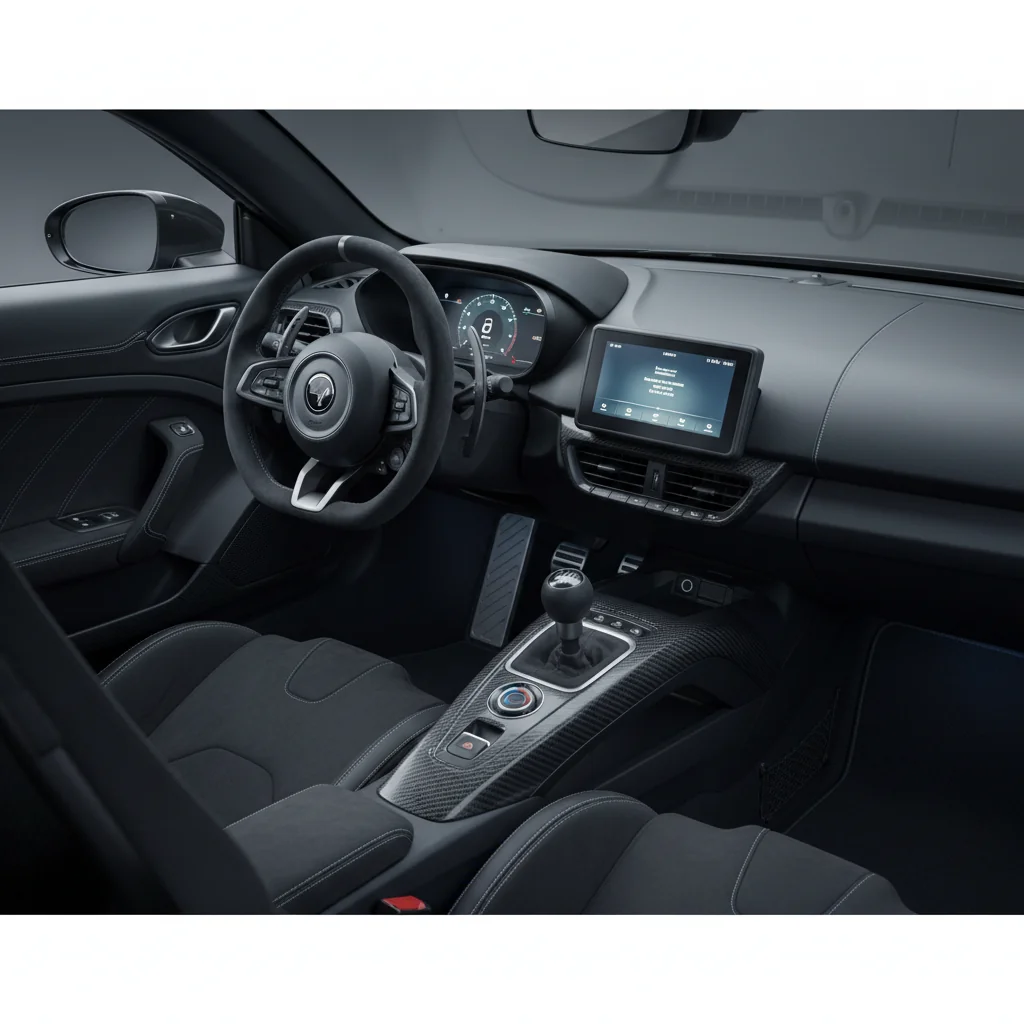
Step inside the A110 R Turini, and the mission statement becomes even clearer: this is a driver’s sanctuary, devoid of unnecessary distractions. The cabin is an exercise in purposeful minimalism, dominated by swathes of Alcantara and exposed carbon fiber. The deeply bolstered, fixed-back Sabelt racing seats, specific to the R Turini, are a work of art. They hug you, cradle you, becoming an extension of the chassis itself, transmitting every ripple and tremor of the road directly to your spine. You don’t sit *in* them; you wear them. The scent of fresh Alcantara and composite resins mingled with a faint, intoxicating whiff of hot rubber and brake dust from my previous laps. It’s a smell that screams performance.
The dashboard, clean and uncluttered, features a digital instrument cluster that prioritizes essential driving information. A large, central tachometer dominates, flanked by readouts for speed, gear selection, and critical temperatures. The small, multifunction steering wheel, also wrapped in Alcantara, feels perfect in hand, its thick rim and flat bottom a tactile delight. While there’s a central infotainment screen, it’s tastefully integrated and thankfully, not the focal point. It provides navigation, media, and connectivity without demanding undue attention. Apple CarPlay and Android Auto are present, but their presence feels almost obligatory, rather than celebrated.
Practicality? Forget about it. This is a two-seater, and while the carbon tub offers surprising rigidity, storage space is an afterthought. A small cubby here, a shallow well there. But that’s the point, isn’t it? This car isn’t about hauling groceries; it’s about hauling ass. Every switch, every button, every dial is precisely weighted, providing satisfying haptic feedback. Even the metallic click of the paddle shifters, a detail so often overlooked, feels substantial, precise, and utterly satisfying. It’s an environment designed to eliminate cognitive load, allowing the driver to focus on one thing and one thing only: the road ahead and the symphony of motion.
The Alpine A110 R Turini is not for the faint of heart, nor for those seeking ultimate bragging rights in a numbers game. This isn’t a car for the boulevard poser. This is a car for the purist, the enthusiast who understands that true driving pleasure isn’t measured in 0-200 mph times or horsepower figures that extend into four digits. It’s for the driver who chases the perfect apex, who revels in the tactile feedback of an unassisted chassis, who appreciates the delicate balance between power and lightness.
This is for someone who values engagement, who wants to feel every input, every reaction, every nuance of the road. It’s for the weekend warrior who finds joy in carving up a canyon road before dawn, or the track day addict who wants a precise, communicative instrument to hone their skills. It’s a rival to the likes of Porsche’s future Cayman GT4 RS, but it offers a distinctly French, almost rebellious, take on the formula – lighter, perhaps more agile, and certainly more emotionally evocative. At an estimated price point likely nudging the higher end of the Alpine range, probably around $95,000 to $100,000, it’s a significant investment. But for the right buyer, it’s not just a car; it’s a philosophy, a choice to embrace a more analog, more involving future. This is for those who understand that less weight, thoughtfully applied…
