The world outside was a smear. A violent, pixelated blur of grey asphalt, green scrubland, and a distant, shimmering heat haze. My chest pressed hard against the harness, blood rushing to my ears, the air expelled from my lungs not by choice but by sheer, unadulterated G-force. There was no roar, no screaming V8, no wailing V10 – just the high-pitched whine of electric motors reaching impossible RPMs, a sound like a million angry bees trapped in a quantum accelerator. This wasn’t driving. This was an instantaneous teleportation event, a warp-speed jump initiated by the deep-seated primal urge to experience the absolute edge of vehicular performance. And the edge? It just kept receding.
First Impressions: Standing Still, It Already Talks
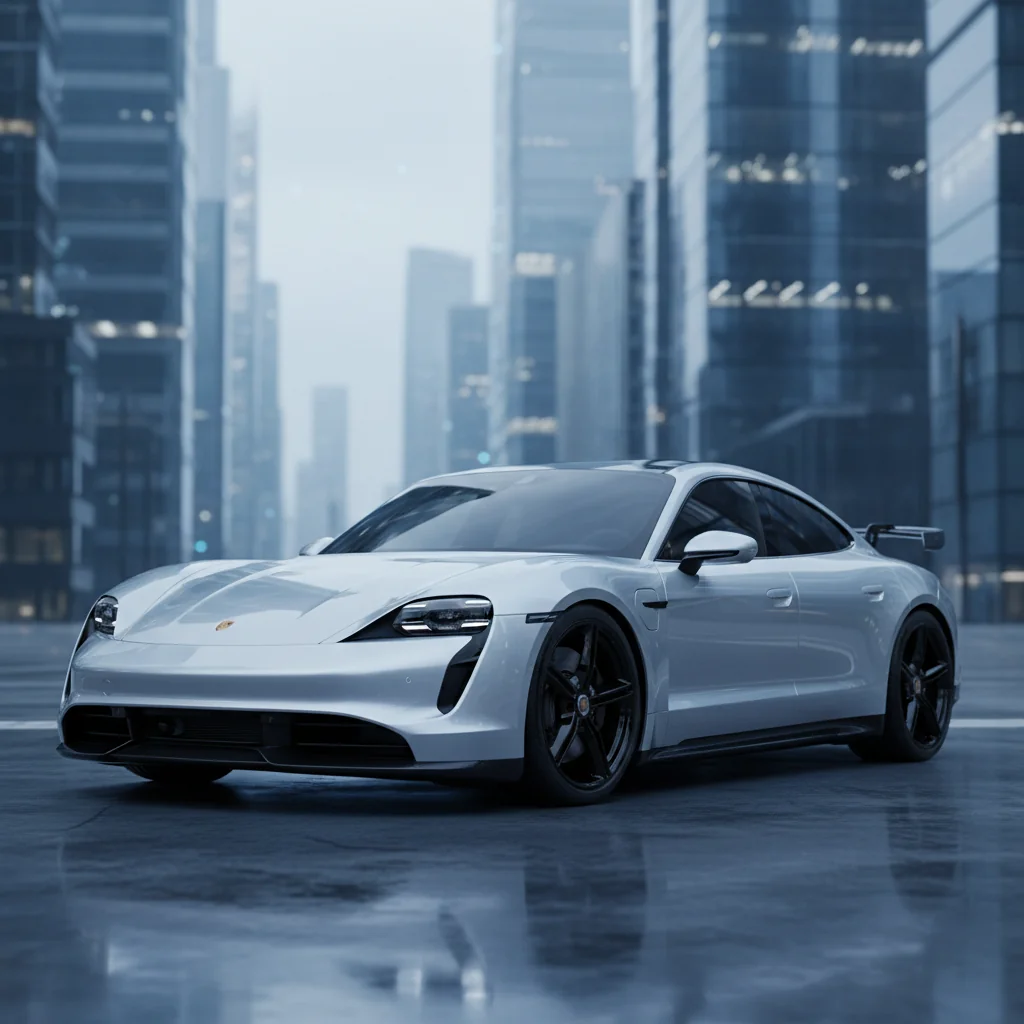
It sat there, menacing. A low-slung, wide-hipped predator coiled in the pit lane, its form sculpted not just by designers, but by the relentless, invisible hand of the wind tunnel. This wasn’t just a Taycan; it was a Taycan that had spent a year in the gym, then another year on the track, shedding every ounce of superfluous fat and replacing it with lean, carbon-fiber muscle. The frozen-blue metallic paint—a shade Porsche calls ‘Shark Blue’—felt impossibly deep, reflecting the harsh track lights like polished obsidian.
The Weissach package, immediately evident, is a brutal declaration of intent. The rear wing, an aggressive blade of exposed carbon, stood sentinel over the impossibly wide rear haunches, ready to cleave the air with surgical precision. Up front, the re-sculpted fascia, with its larger air intakes and deep splitter, seemed to inhale the very atmosphere. Carbon fiber was everywhere: the mirrors, the B-pillars, the side skirts, the rear diffuser. Even the wheels, a unique forged design, revealed glimpses of the massive carbon ceramic brakes, their yellow calipers promising an equally violent deceleration. There’s a certain purity to its aggression; it doesn’t shout, it hums with an ominous promise. Before I even opened the door, a scent – faint, metallic, almost electric – wafted from the cooling brakes of the previous run, a ghost of its recent fury. It looked fast. Not just fast, but terrifyingly, record-breakingly fast. It was an aesthetic of pure, uncompromised speed.
Under the Hood: Where Electrons Ignite a Sonic Boom
There is no “hood” in the traditional sense, of course, just a tightly packaged front trunk. The real magic lies beneath the floor and within the axles. Dual electric motors, one on each axle, are the heart of this beast, pumping an astounding 1108 horsepower to all four wheels. Think about that number for a moment: one thousand, one hundred and eight. It’s a figure that would have seemed fantastical a decade ago, reserved for hypercars built in impossibly small batches. Here, it’s delivered with the kind of immediate, unlagging force that only electrons can provide.
Porsche engineers, those meticulous guardians of performance, haven’t just bolted on bigger motors. They’ve optimized every electron, every cooling duct, every line of code to deliver this power not just ferociously, but predictably. The sound at full throttle, a high-frequency thrum that vibrates through the carbon fiber bucket seat, is unique. It’s the sound of immense, efficient mechanical violence, the gears of the two-speed rear transmission engaging with a subtle yet perceptible shift, ensuring relentless pull well into triple-digit speeds.
The numbers are staggering. Engage “Attack Mode,” a new overboost function for brief bursts of maximum power, and the Taycan Turbo GT Weissach explodes from 0-60 mph in a mind-bending 1.9 seconds. Two seconds. The world outside your window goes from static to scenery in less time than it takes to blink. The quarter mile flashes by in a blistering 8.8 seconds. This car isn’t just quick; it’s a recalibration of what “fast” truly means. Under hard braking, the carbon ceramics, an absolute necessity at these speeds, haul the two-and-a-half-ton missile from 60-0 mph in a brutal 92 feet. Physics, it seems, has been put on notice.
On the Road: A Dance with Untamed Electrons
Slipping into the lightweight carbon bucket seat, the Weissach package makes its presence felt immediately. No rear seats here, just a carbon fiber bulkhead and a cargo net – a brutalist declaration of purpose. The steering wheel, wrapped in grippy Alcantara, felt perfectly sized, its rim substantial. My palms, still slightly sweaty from the previous machine, immediately recognized the familiar Porsche weight. This wasn’t a video game controller; this was a direct conduit to the front wheels.
Out of the pits, the Taycan felt taut, firm, but not jarring. Porsche’s adaptive air suspension and active anti-roll bars work in concert, allowing just enough body motion to communicate what the chassis is doing, but never enough to upset its composure. The first corner, a fast, sweeping left-hander, arrived with startling speed. Turn-in was surgical, the front end biting with an eagerness that defied its weight. There was no hesitation, no slop, just an immediate, unyielding connection to the apex. My unexpected personal observation? The way the steering wheel vibrates subtly under hard cornering, not a bad vibration, but a living, breathing feedback, as if the tires themselves are whispering secrets up the column.
Mid-corner, the 1108 horsepower is a double-edged sword. Push too hard, too early, and the electronics will intervene, but with an almost telepathic grace, scrubbing speed without drama. Learn to trust it, to feel the limits, and you can lean on the Taycan GT’s immense grip (lateral Gs pushing 1.25) through the entire arc of the corner, the torque vectoring system distributing power with microscopic precision. Coming out of the corner, the world warps again. The car hunkers down, squatting on its rear axle, unleashing its full force. It’s not just acceleration; it’s an event horizon. The sheer force felt like a giant hand pushing me into the seat, a constant, unrelenting shove that didn’t diminish as the speedometer climbed past 100, then 120, then 150 mph. The wind noise, a faint howl around the A-pillars, was the only real indication of the speed, the motors maintaining their furious, high-pitched song. Braking for the next chicane was equally brutal. The carbon ceramics bit hard, scrubbing speed with astonishing ferocity, the scent of hot pads and rotors momentarily filling the cabin. The Taycan Turbo GT Weissach doesn’t merely defy its electric nature; it redefines what a track-focused GT car can be, electric or otherwise. It is a precision tool, honed to a razor’s edge.
Inside the Cabin: Surgical Precision Meets Spartan Intent
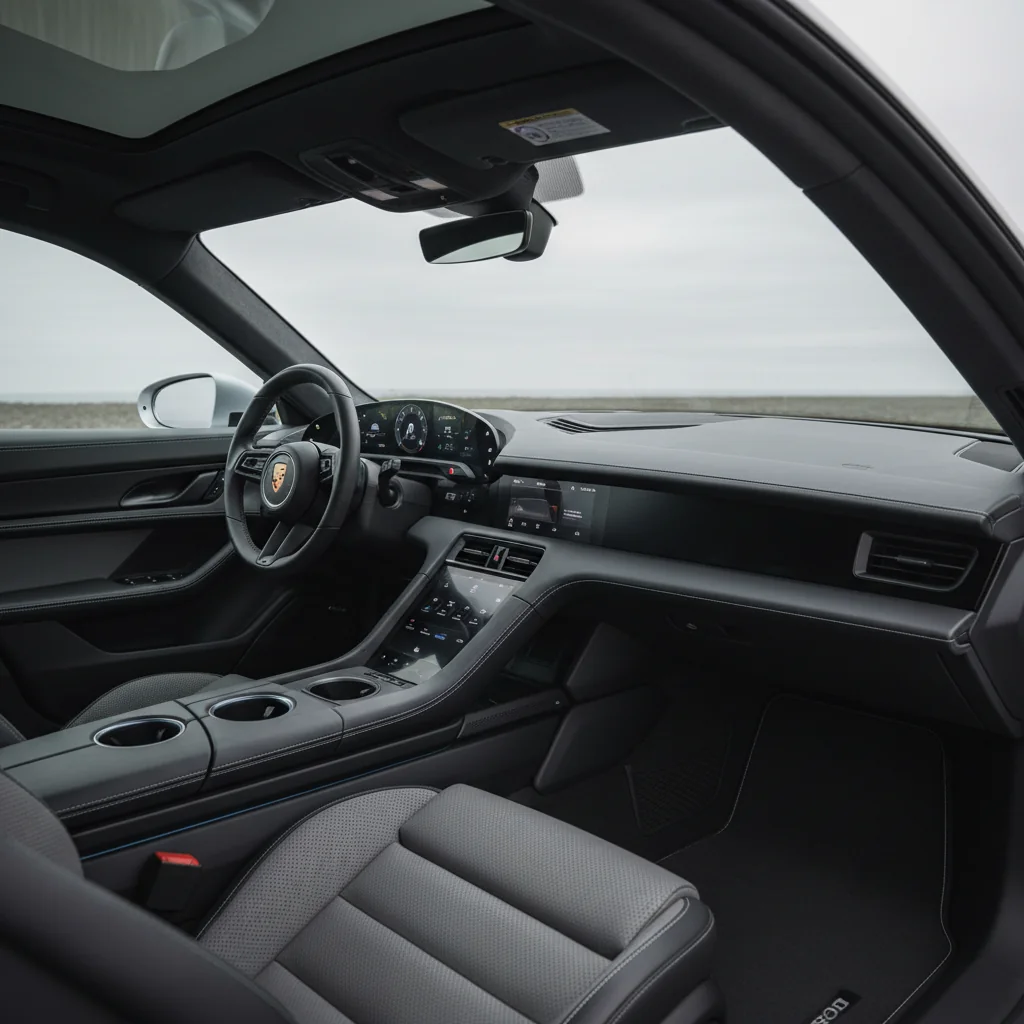
The interior of the Taycan Turbo GT Weissach is a masterclass in Porsche’s philosophy of functional elegance, though with a distinctly more spartan, track-focused edge thanks to the Weissach package. Gone are the plush rear seats, replaced by a carbon fiber shelf that saves weight and visually reinforces the car’s single-minded purpose. The front seats, lightweight carbon fiber shells clad in a combination of leather and Alcantara, hug the body with reassuring firmness. They are comfortable enough for a long drive, but clearly designed for serious lateral loads.
The driver’s cockpit is all business. The curved digital instrument cluster remains, clear and customizable, prioritizing essential driving information. The central infotainment screen, a familiar Porsche unit, handles navigation, media, and car settings with crisp graphics and intuitive touch responses. A smaller screen for the passenger is available, though in this Weissach-spec machine, its presence felt almost secondary to the pure driving experience. Material quality is, as expected from Porsche, impeccable. Alcantara adorns the steering wheel, roof lining, and door panels, punctuated by exposed carbon fiber trim that looks and feels genuinely structural, not merely decorative. The switchgear operates with that satisfying, damped precision that is uniquely Porsche. Ergonomics are spot-on; every control, from the drive mode selector to the climate switches, falls readily to hand. There’s an almost monastic focus on the driver, a clear message that while the technology is advanced, it is always in service of the person behind the wheel, never dominating the experience. It feels less like a gadget-filled lounge and more like a fighter jet cockpit, streamlined for maximum efficiency.
Who Should Buy the Porsche Taycan Turbo GT Weissach?
This isn’t a Taycan for everyone, nor is it meant to be. The Porsche Taycan Turbo GT Weissach is for the discerning enthusiast who craves the absolute pinnacle of electric performance, who sees lap times not as bragging rights, but as a measure of engineering excellence. It’s for the driver who spends weekends at the track, who demands precision and feel above all else, even in an electric vehicle. This is for someone who already owns a GT3 RS and wants to explore the cutting edge of EV technology without sacrificing the tactile, engaging driving experience Porsche is famous for.
It’s a direct challenger to the likes of the Lucid Air Sapphire or even the Tesla Model S Plaid, but where those cars offer ludicrous speed, the Porsche elevates the experience with an unparalleled level of chassis communication, braking prowess, and track-focused refinement. The Taycan GT Weissach is not just fast; it’s *Porsche* fast, which means a holistic, confidence-inspiring performance package. Expect pricing to start around $285,000, placing it squarely in hypercar territory, a price tag justified by its record-breaking capabilities and the Weissach badge.
Final Verdict
The 2026 Porsche Taycan Turbo GT Weissach isn’t just an electric car; it’s an electric event. Porsche has not merely dipped its toe into the high-performance EV pool; it has cannonballed in, sending shockwaves through the entire industry. This car shatters preconceptions about electric vehicles, proving unequivocally that the soul of driving can thrive, even without the roar of an internal combustion engine…