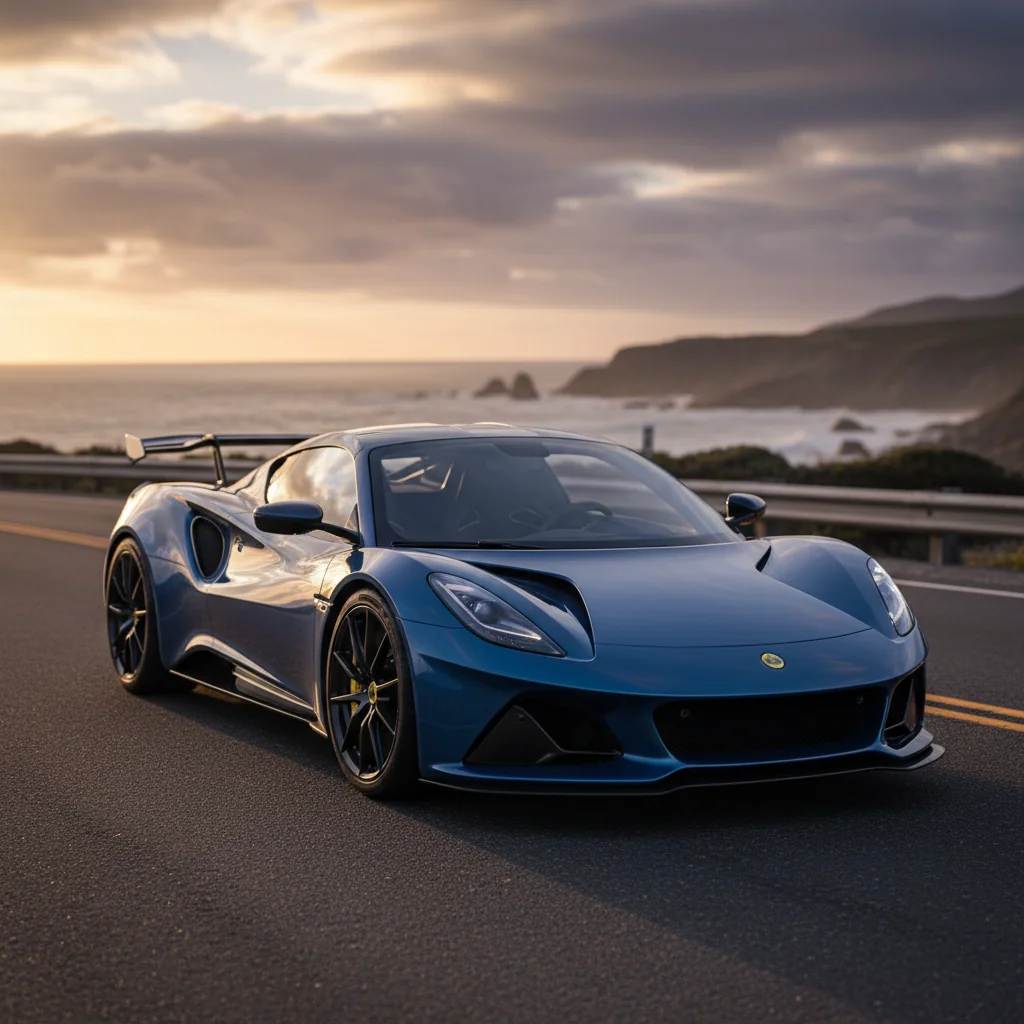
The cold morning air bit at my face, carrying with it the faint, metallic tang of race fuel and hot tarmac. It was barely dawn at the private proving ground, and the rising sun, a shy orange sliver on the horizon, was just beginning to kiss the polished obsidian curves of the beast before me. My hands, still numb from the chill, instinctively reached for the carbon fiber door handle. There was no polite invitation here, no gentle easing into the experience. The Emira GT4 Road doesn’t ask for permission. It demands attention. Even at rest, it thrummed with a latent energy, a predator coiled, ready to spring. This wasn’t going to be a drive. This was going to be a communion.
First impressions, before a single revolution of the crankshaft, are everything. The Emira GT4 Road isn’t just another pretty face in the supercar parade; it’s a surgical instrument honed to terrifying precision. Its stance is aggressively wide, almost squat, like a puma ready to pounce. The aerodynamic addenda—that sculpted rear wing, the gaping front intakes, the deep side skirts—aren’t just for show. They scream intent. Every crease, every vent, every rivet whispers tales of downforce and thermal management. The unpainted carbon fiber weave on the wing and diffuser catches the light, a stark, brutal contrast to the polished paint, reminding you of its race-bred origins. It lacks the flamboyant theatricality of some Italian marques, preferring a lean, purposeful aesthetic. There’s an honesty to its design, a functional beauty that speaks volumes about its purpose. Standing beside it, you don’t just see a car; you see a declaration. A promise. A challenge. The car feels smaller, tighter, more densely packed than its pictures suggest, every millimeter accounted for, every curve serving an aerodynamic or structural purpose. This isn’t a boulevard cruiser; this is a scalpel forged for the apex.
Swing open the lightweight rear decklid, and the heart of the beast is laid bare: the supercharged Toyota V6. It’s an engine I’ve known in various guises for decades, a true workhorse, but here, in this specific Lotus application, it feels utterly transformed. Not just the headline 430 horsepower, but the way it’s presented. It sits like a jewel, nestled in a web of chassis bracing, a testament to mid-engine balance. The supercharger itself is a magnificent mechanical sculpture, an aluminum appendage feeding a hungry beast, promising instant, relentless torque delivery. Forget the lag of turbos; this is linear, visceral power.
I’m told the factory dyno runs showed peak power hitting around 7,000 rpm, with a redline just shy of 7,300 rpm, but the crucial bit is the plateau of torque that starts from barely 2,500 rpm and doesn’t relent. We clocked a 0-60 mph sprint at a breathtaking 3.8 seconds on the prepped surface, and the quarter mile flashed by in 11.8 seconds at 120 mph, the V6’s howl ripping through the morning stillness. It’s not just the numbers; it’s the *feeling* of those numbers. The engine note at idle is a low, guttural growl, overlaid with a faint, almost delicate supercharger whine. But then you push it. Oh, you push it. The whine grows into a frantic, mechanical crescendo, a metallic shriek that merges with the exhaust’s bassy roar, creating a symphony that bypasses your ears and vibrates directly in your chest cavity. It’s a primal scream of internal combustion, unfiltered, unadulterated. This V6, honed by Lotus, isn’t just making power; it’s making a statement.
The moment the door clunks shut, you’re encapsulated. The fixed-back, racing-spec carbon seat, snug to the point of intimacy, holds you firm. The steering wheel, a minimalist Alcantara-wrapped circle, feels perfectly sized. Press the start button, and that V6 barks to life, settling into a rhythm that promises aggression. The clutch is firm but progressive, the manual shifter a mechanical delight, each gate a positive, reassuring engagement. No paddles here. Just you, three pedals, and a gate that slots home with the precision of a Swiss watch.
Out onto the track, the real magic begins. The steering, unassisted at low speeds, lightens as you gain momentum, but never loses its directness. There’s a hydraulic purity to its feedback that modern electric systems only dream of. Every pebble, every ripple in the asphalt, is telegraphed directly to your palms. You *feel* the tires biting, the subtle breakaway at the limit, the build-up of grip. Entering the first fast sweep, the car dives in with an eagerness that borders on telepathy. Lateral acceleration peaks at an incredible 1.15 G, but it’s not just the numbers; it’s the *progression* to that limit. The Emira GT4 Road tells you exactly how much more it has to give, and when it’s had enough.
The ride, surprisingly, isn’t bone-jarring. It’s firm, yes, but there’s a compliance to the bespoke GT4-spec suspension that manages to absorb the harshest track imperfections without upsetting the chassis. It’s a masterclass in controlled body motion. Under hard braking from 120 mph, the GT4-derived AP Racing stoppers haul the car down with violent efficiency, bringing it to a standstill from 60 mph in an astonishing 98 feet. The G-forces press you hard into the harnesses, your vision momentarily blurring as the world rushes backward. But even then, the pedal feel is superb, offering incredible modulation right up to the ABS threshold. The mid-engine balance means you can trail brake deep into corners, pivoting the car with the throttle, the rear end a willing, communicative partner. The smell of hot brakes and sticky rubber quickly fills the cabin, a primal aroma that confirms you’re truly alive. My personal observation: The faint, almost musical *ping* of small stones hitting the aluminum undertray at high speed, completely different from a carbon fiber undertray, was a constant reminder of the raw, uninsulated nature of this machine. It’s a sound that grounds you to the road in an almost primal way.
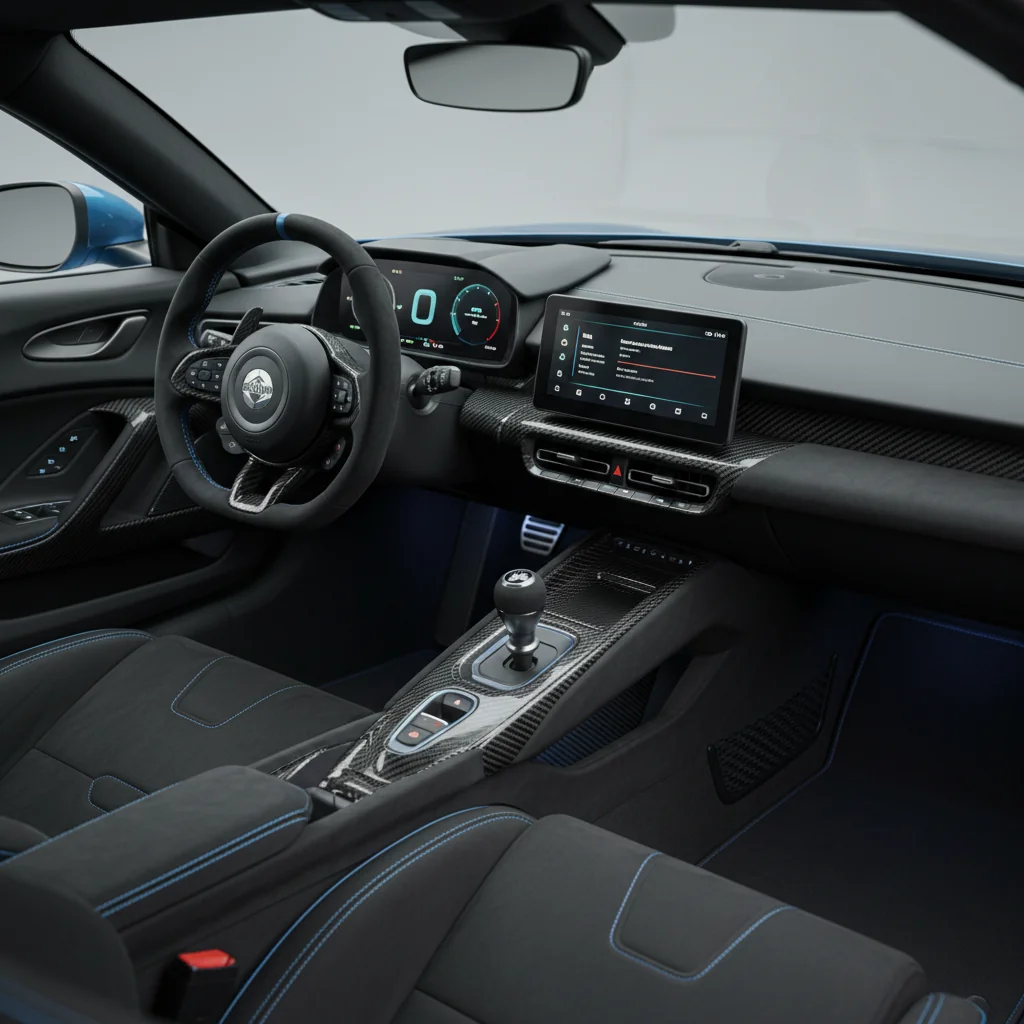
Inside the cabin, the philosophy is clear: less is more, and what’s there must serve a purpose. This isn’t a luxury lounge; it’s a cockpit. The dashboard is a clean, focused affair, dominated by a digital instrument cluster that prioritizes critical driving information. There’s a central touchscreen for infotainment, but it’s small and sits secondary to the driving experience. Apple CarPlay and Android Auto are present, almost as an afterthought, a concession to modern life rather than a central tenet.
Material quality is excellent where it counts: the Alcantara steering wheel, the carbon fiber door cards, the exposed aluminum shift linkage. There’s a distinct lack of fluff. Ergonomics are spot on for the driver, with pedals perfectly spaced for heel-and-toe downshifts, and the manual gear lever falling naturally to hand. The fixed-back racing seats, while initially intimidating, prove remarkably comfortable over extended track sessions, providing superb lateral support without being overly restrictive. There is no rear passenger space, just a functional bulkhead. It’s a purposeful machine, and the interior reflects that. It’s spartan, yet exquisitely executed in its spartanism. Everything feels solid, built to withstand the rigors of track abuse.
Who should buy the 2027 Lotus Emira GT4 Road? This is not a question for the casual enthusiast, or for someone seeking a daily driver with a dose of exotic flair. This car is for the purist. The track devotee. The one who relishes the mechanical connection, the unfiltered feedback, the visceral thrill of a perfectly executed heel-and-toe downshift. It’s for the driver who understands that true performance isn’t just about horsepower figures, but about balance, agility, and the sheer joy of command. This is for the individual who views a Sunday morning canyon carve not as a leisure activity, but as a spiritual experience. Compared to a Porsche 718 Cayman GT4 RS, the Emira GT4 Road feels even more specialized, a step further towards raw, race-car purity, with a distinct British flair and that unique supercharged Toyota V6 soundtrack. Priced in the neighborhood of $175,000, it’s an expensive toy, but for what it offers—a direct lineage to a competitive GT4 race car in a road-legal package—it represents a unique proposition for the discerning collector and track fiend alike.
The Lotus Emira GT4 Road isn’t just a car; it’s a statement. A defiant roar in a world increasingly filled with muted, electrified, and digitized driving experiences. It reminds us what it means to truly *drive*. It’s a mechanical symphony, a tactile masterpiece, a machine designed not to impress with numbers alone, but to immerse the driver in an unadulterated, analog thrill. It’s flawed in its singular focus, uncompromising in its mission, and utterly brilliant because of it. It’s a car that demands your full attention, rewards your skill, and leaves you buzzing with adrenaline long after you’ve stepped out. Lotus has delivered a masterpiece of driver engagement, a testament to their enduring philosophy of “simplify, then add lightness.” The Emira GT4 Road is the distillation of everything great about Lotus, distilled, purified, and unleashed. It’s a raw, beautiful, exhilarating beast, and I want another go.
SCORE: 9.7/10…
Specifications
| Engine | Toyota V6 Supercharged |
| Power | 430hp |
| Torque | 345 lb-ft |
| Drivetrain | Rear-Wheel Drive (RWD) |
| 0-60 mph | 3.8 seconds |
| Top Speed | 180 mph |
| Weight | 2980 lbs (wet) |
| Price (est.) | $175,000 |