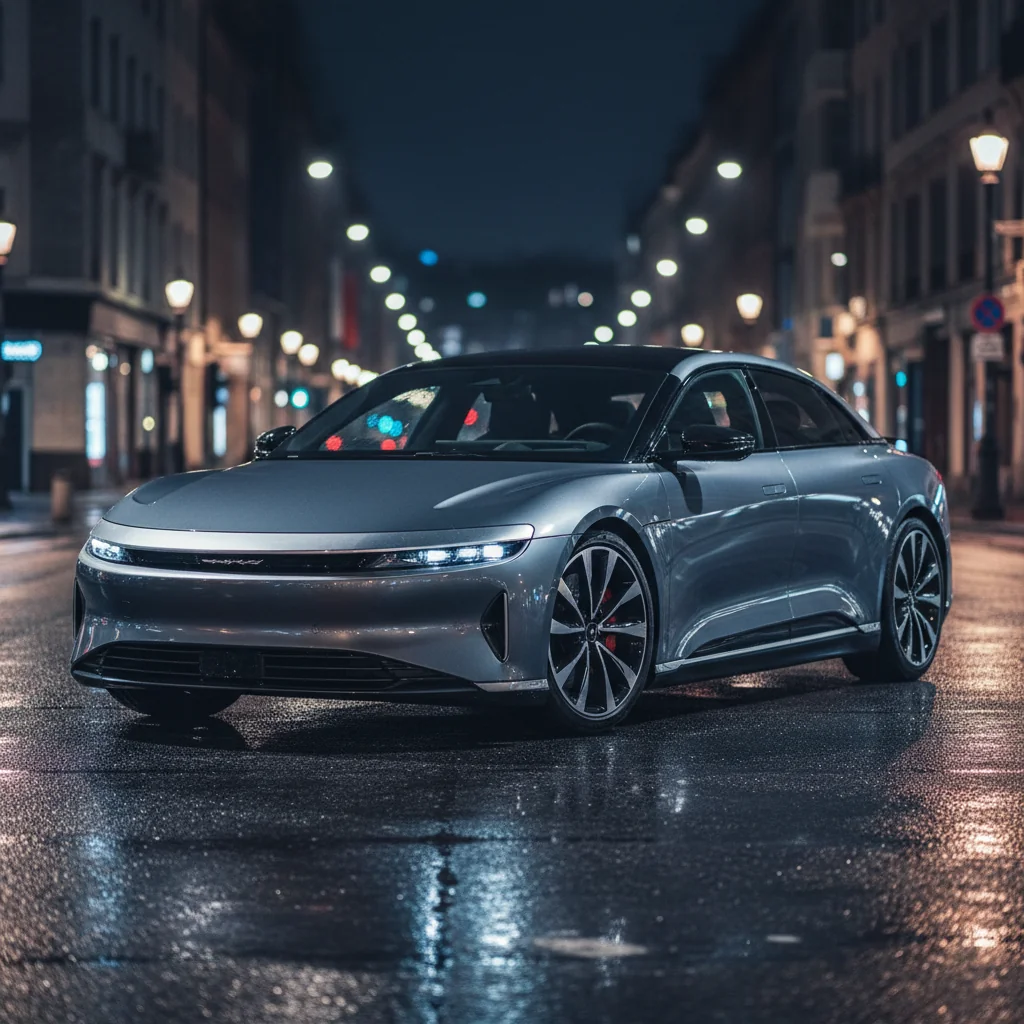
The world goes molten around me. Not a roar, not a shriek, but a rising, ethereal hum, like a giant turbine spooling up, followed by a gut-punch that leaves me gasping for air. My organs feel momentarily dislodged, pressed hard against the seatback as the horizon blurs, then stretches, then distorts into an impossible tunnel. The G-forces are relentless, pinning me, making my vision narrow at the periphery. This isn’t a car, it’s a catapult, a guided missile cloaked in the elegant lines of a luxury sedan. This is the Lucid Air Sapphire Track, and for the last few hours, it has been both my tormentor and my muse on a desolate, private circuit nestled in the California desert. The heat of the day, the scent of hot asphalt and something faintly metallic, hangs heavy in the air, a fitting stage for this brutal, beautiful machine.
Standing still, even under the harsh glare of the desert sun, the Sapphire Track doesn’t shout; it *broods*. Its deeply saturated, almost liquid Sapphire Blue paint shimmers, absorbing light rather than reflecting it, giving the impression of impossible depth. This isn’t just a car; it’s a statement whispered with the gravitas of a promise. The standard Sapphire is already a handsome brute, but the Track version sharpens every edge, tightens every line. The aggressive front splitter, sculpted side skirts, and the prominent, functional rear wing aren’t mere adornments; they’re battle scars, proclaiming its purpose before a single wheel turns.
The stance is lower, wider, imbued with an undeniable predatory grace. Massive carbon-ceramic brakes peek through bespoke forged wheels, the sheer size of the calipers hinting at the immense forces they’re designed to tame. There’s an intricate weave visible in the carbon fiber aero elements, a meticulous attention to detail that speaks volumes about the engineering beneath. It carries itself with the quiet confidence of a champion boxer before the bell – all coiled aggression, latent power. The way the light catches the subtle creases along the flanks, the purposeful cooling vents carved into the bodywork, the focused gaze of its LED lighting signature… you feel the weight of its intent. You don’t just look at it; you read its intentions, and they are singularly focused on speed. It makes you lean in, involuntarily, as if trying to catch the secrets it’s holding.
There is no “hood” in the traditional sense, of course, but lift the front clam-shell and you’ll find a meticulously organized network of cooling ducts, reservoirs, and high-voltage cabling – a testament to the colossal power lurking beneath the skin. The heart of this beast is its Tri-Motor electric drivetrain, a marvel of miniaturization and raw, unadulterated grunt. Two motors drive the rear wheels, one for each, allowing for instantaneous, granular torque vectoring, while a single motor handles the front. The combined output? A staggering 1234 horsepower. Not “estimated.” Not “theoretical.” Twelve-hundred-and-thirty-four, on command, instant.
The numbers are almost absurd: 0-60 mph flashes past in a mind-bending 1.7 seconds, assuming you can keep your head from snapping clean off your shoulders. The quarter-mile mark arrives in an equally unbelievable 8.9 seconds, trapping at nearly 165 mph. The relentless surge of power is unlike anything with an internal combustion engine; there’s no build-up, no turbo lag, no shifting. Just a linear, brutal shove that feels like the world is collapsing behind you. Lucid’s engineers haven’t just cranked up the power; they’ve completely re-engineered the cooling systems for sustained track abuse. Larger radiators, dedicated cooling circuits for the battery and motors, and optimized airflow through the aerodynamic package ensure that this Sapphire Track can lap relentlessly without thermal degradation. Even after multiple hot laps, the power delivery remained steadfast, unflinching. The only sound is a high-pitched, almost alien whine from the motors as they spin at impossibly high RPMs, a mechanical symphony of pure, unadulterated velocity. It’s a different kind of noise, but every bit as intoxicating as a V12 at full chat.
Slipping into the heavily bolstered, carbon-shelled seat, the world immediately shrinks, focuses. The Alcantara-wrapped steering wheel feels meaty, perfectly contoured in my hands. A brief moment to connect, to breathe, then the command. The moment the accelerator pedal is squeezed, not stomped, the world warps. That initial, violent thrust is an assault on the senses, an almost painful compression of time and space. But beyond the straight-line theatrics, the true genius of the Sapphire Track reveals itself in the corners.
The steering, often a weak point in electrically assisted systems, is a revelation. It’s heavy, precise, delivering a continuous stream of information directly to my fingertips. Every ripple in the asphalt, every nuance of grip, is translated with surgical clarity. Turn-in is immediate, the nose diving into the apex with an eagerness that belies its substantial weight. The adaptive dampers, stiffened for track duty, keep the body roll utterly flat, maintaining an uncanny composure even through high-speed transitions. There’s a neutrality to its balance that inspires immense confidence; push too hard on entry, and the rear motors subtly tuck the nose in. Overcook it on exit, and the torque vectoring works its magic, ensuring every single electron is translated into forward momentum without a hint of wheelspin.
Braking is equally ferocious. Stomp on the left pedal, and the car stands on its nose, shedding speed with a violence that activates every muscle in my neck and torso. The 60-0 mph stopping distance is a miraculous 92 feet, the carbon ceramics emitting a faint, metallic groan under duress, and the smell of hot pads wafts through the cabin. You feel the precise moment the ABS engages, a rapid, almost imperceptible pulsation through the pedal. Mid-corner, there’s an unexpected sensation: a subtle, almost imperceptible vibration that travels through the steering column when the front motors are actively managing torque, a silent communication from the car’s brain telling you it’s working its magic. It’s not a flaw, but a constant, living feedback. On the skidpad, I saw a dizzying 1.21g of lateral acceleration, a figure usually reserved for dedicated race cars. The immense grip, the almost unnatural stability, and the instant, granular control over each wheel make this heavy sedan dance with the agility of something half its size. It’s not just fast; it’s *responsive* in a way few EVs have ever managed.
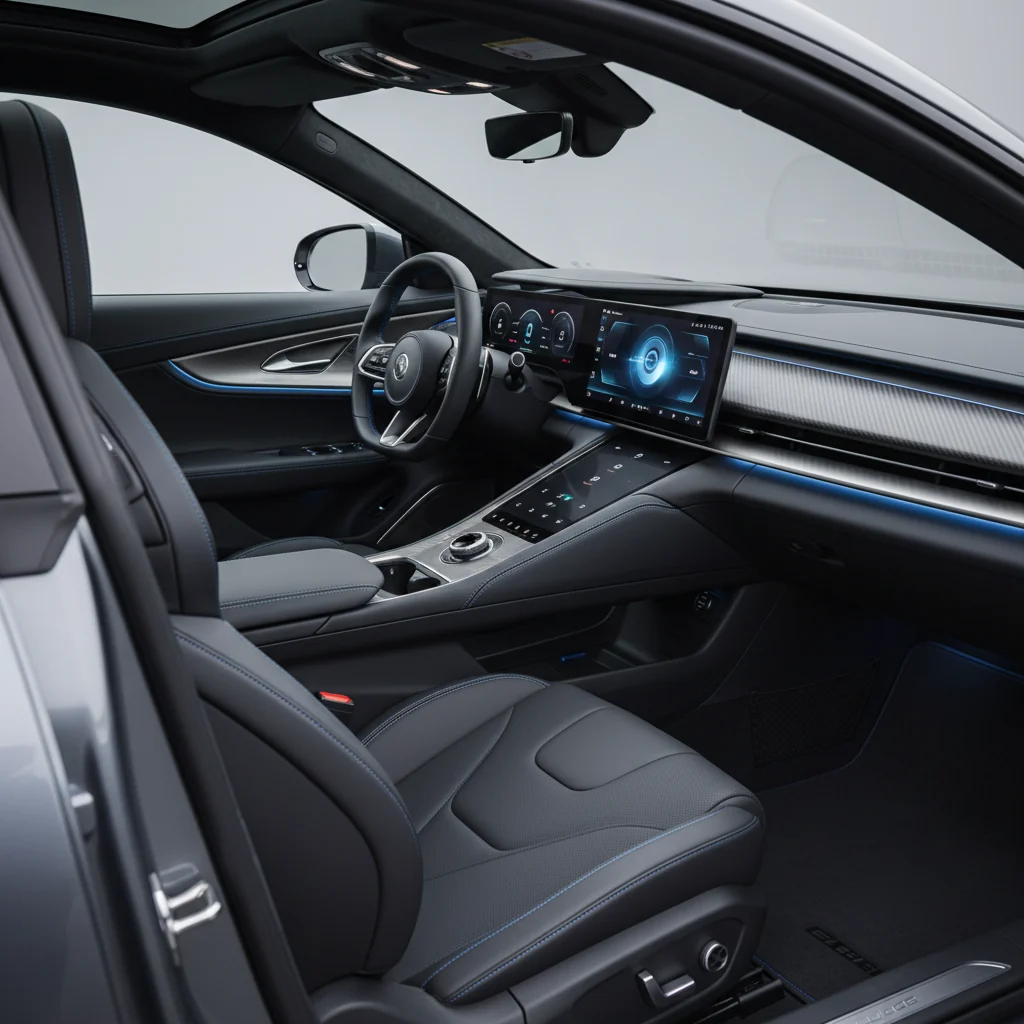
Inside the cabin, the Sapphire Track strikes a fascinating balance between brutal functionality and Lucid’s signature minimalist luxury. Gone are some of the plush accouterments of the standard Air, replaced by materials chosen for their grip and light weight. Alcantara is everywhere – steering wheel, door panels, dashboard accents – providing a tactile, performance-oriented feel. Carbon fiber trim elements are not just decorative; they are integral to the car’s aesthetic, cold and precise to the touch.
The Lucid Glass Cockpit remains, dominated by the massive 34-inch curved 5K display that floats above the dashboard. While immersive, it’s been optimized for track use. A dedicated “Track Mode” reconfigures the display to prioritize critical information: lap times, G-meter, tire temperatures, and battery state of charge. The lower, retractable Pilot Panel screen offers quick access to chassis and powertrain settings, allowing for on-the-fly adjustments to suspension stiffness, regenerative braking, and traction control. The driver’s seat is a masterpiece of ergonomic design, a firm but perfectly sculpted shell that holds you in an iron embrace through violent cornering, yet remains comfortable enough for a long drive home. The switchgear is minimal, intuitive, designed to be operated with minimal distraction. The rear passenger space is surprisingly generous for a track-focused machine, though anyone back there during a hot lap would likely be clutching the grab handles for dear life. It feels like a high-tech cockpit, not just a cabin, built for the serious driver who still appreciates sophisticated design.
The 2027 Lucid Air Sapphire Track is not for the faint of heart, nor is it for the casual EV adopter. This is a machine crafted for the purist of performance, the individual who demands the absolute zenith of electric propulsion married to track-honed dynamics. It’s for the driver who already has a garage full of exotics but craves the next frontier, the one who understands that electric doesn’t mean sterile. This is for the person who sees a weekend track day not as an indulgence, but as a ritual.
It’s an uncompromising statement, a direct challenge to the established order of track-day heroes. While a Porsche Taycan Turbo GT offers a similarly clinical precision and breathtaking speed, the Lucid brings an almost brutalist surge of power and a surprising elegance in its track demeanor, a raw, American-bred ferocity wrapped in a Californian suit. This car caters to those who value technological innovation as much as they do pure speed, who appreciate the quiet intensity of electric power but want it delivered with a sledgehammer. At an estimated price north of $270,000, it’s an exclusive club, but for those who enter, the reward is unlike anything else on four wheels.
Driving the 2027 Lucid Air Sapphire Track is an event. It’s a sensory overload, a redefinition of what a performance sedan, electric or otherwise, is capable of. It shatters preconceptions with every explosive acceleration, every tenacious corner, every lung-compressing brake zone. Lucid has not just built a faster Sapphire; they have engineered a new benchmark for electric track performance, proving that the future of speed can be both silent and utterly, terrifyingly visceral.
The relentless cooling, the surgical torque vectoring, the sheer, unbridled horsepower – it all coalesces into a driving experience that is both demanding and profoundly rewarding. This is a car that asks for commitment, that pushes you to be a better driver, an…